
Chicago’s 580 parks are littered with statues of historically significant men. Some of these men may be familiar to you: Nicolaus Copernicus, Benjamin Franklin, Abraham Lincoln. Others may be unfamiliar: Greene Vardiman Black, for example, the “father of modern dentistry.” While the accomplishments of these notable figures vary, their gender does not. In fact, there is not a single statue in Chicago that honors a historically significant woman.
The lack of public statues honoring women has received recent attention in the local media, and for good reason. In a city home to such important female leaders like Ida B. Wells and Jane Addams, how can public depictions of women remain absent in Chicago’s parks?
The Chicago Park District told WBEZ Chicago that this absence is an issue of timing; the heyday of public sculpture in the city occurred before women earned the right to vote and were therefore not involved in public life. Yet this argument does not explain why men continued to be honored in Chicago parks long after women earned the right to vote in 1920. As recently as 2006, the Chicago Park District has added a new bronze statue of a male figure to its expansive park system.
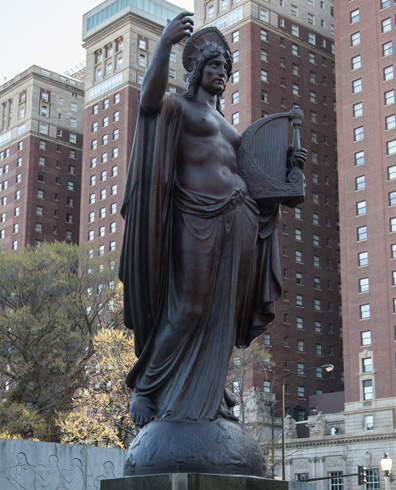
Three rare (only?) examples of statues of women in Chicago are either virtuous goddesses or child-centered fictional characters. First, there is a bronze statue of a topless goddess in Grant Park titled “The Spirit of Music.” Dedicated to Chicago Symphony Orchestra founder Theodore Thomas, the muse represents “The Lady of Music, Art, Prose, Poetry and Drama.”
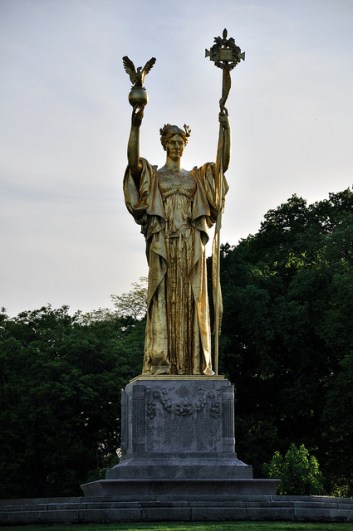
Second, the 1918 replica “Statue of the Republic” in Jackson Park – affectionately known as “Big Mary” or “The Gold Lady” – similarly depicts a gold-gilded goddess of Liberty and republican virtue.
And finally, Chicago’s Oz Park is home to the 2007 statue of Dorothy from the beloved children’s story, The Wizard of Oz.

The absence of real women in public sculpture is not unique to Chicago. In New York City’s Central Park, there are 22 statues of male figures and only 2 statues of female figures. Like Chicago’s Dorothy, the 2 women represented in Central Park are fictional characters from children’s stories: Alice from Alice in Wonderland and Mother Goose.
When compared to the nearby figures of Christopher Columbus and Alexander Hamilton, the statues of Alice and Mother Goose suggest that women have not contributed to history or, at the very least, that their contributions are entirely symbolic. They hint at the larger misconception that men are the sole agents of historical change.
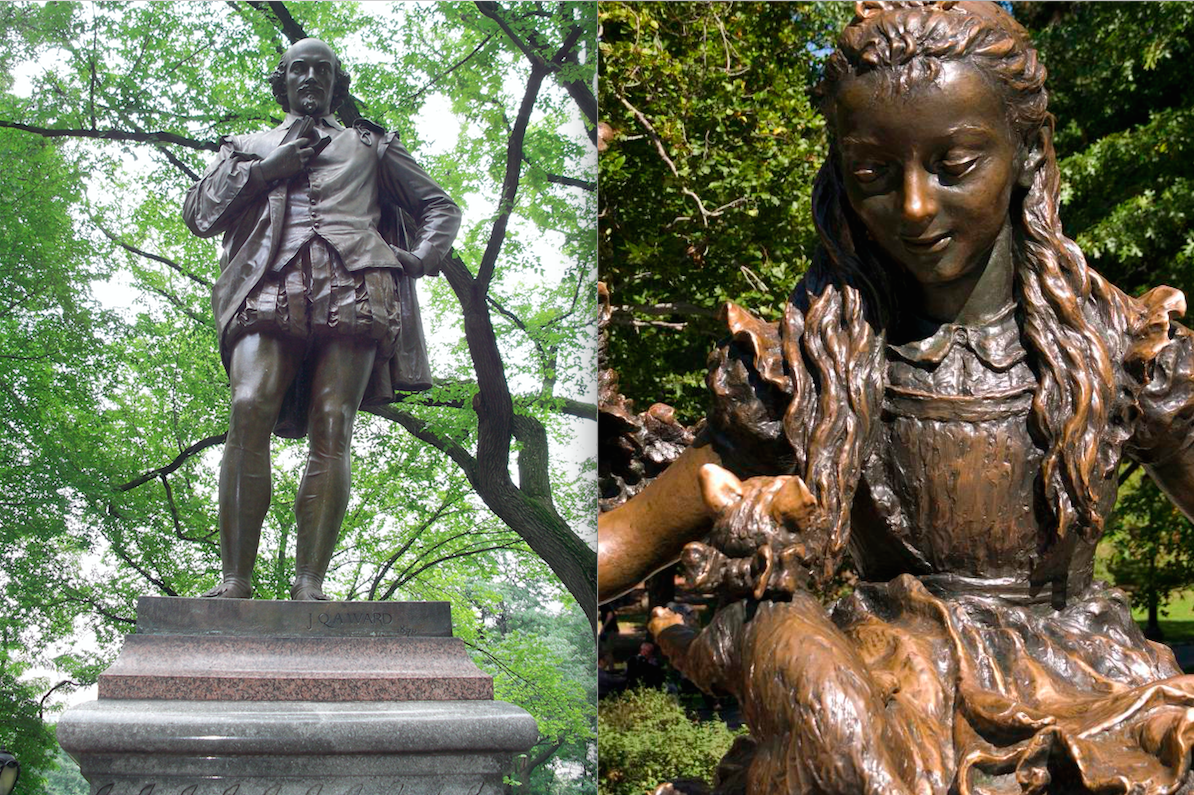 William Shakespeare and Alice in Central Park
Why should this matter to public historians? It matters because sites associated with women’s history in cities like Chicago and New York have not always been preserved. Because of this, statues of historic women in public urban spaces like parks are essential to integrate women back into the built environment.
In the last decade, the Chicago Park District has renamed over 40 parks after historically significant women. There is a recent effort in New York to correct the sculptural gender imbalance in Central Park and a current project in Chicago to build an Ida B. Wells monument in Bronzeville. These are important steps towards increasing the visibility of women’s history in the urban landscape.


 The Lakefront Historian
Leave a comment